“Who’s that good looking guy over at the pool table?”
The opening notes of The Animals’ “Talkin’ Bout You” ring throughout the theater as Austin Butler’s Benny, casually leaning over a pool table, lifts his head up in the middle of a game. And…ho-ly shit.
If writer/director Jeff Nichols’ goal was for the audience to lose its breath along with Jodie Comer’s Kathy as she lays eyes on Benny for the first time, then job well done, sir. Elvis may have put the BAFTA-winning Butler on the audience’s collective radar, but Nichols seems intent on making the actor a bonafide movie star with The Bikeriders.
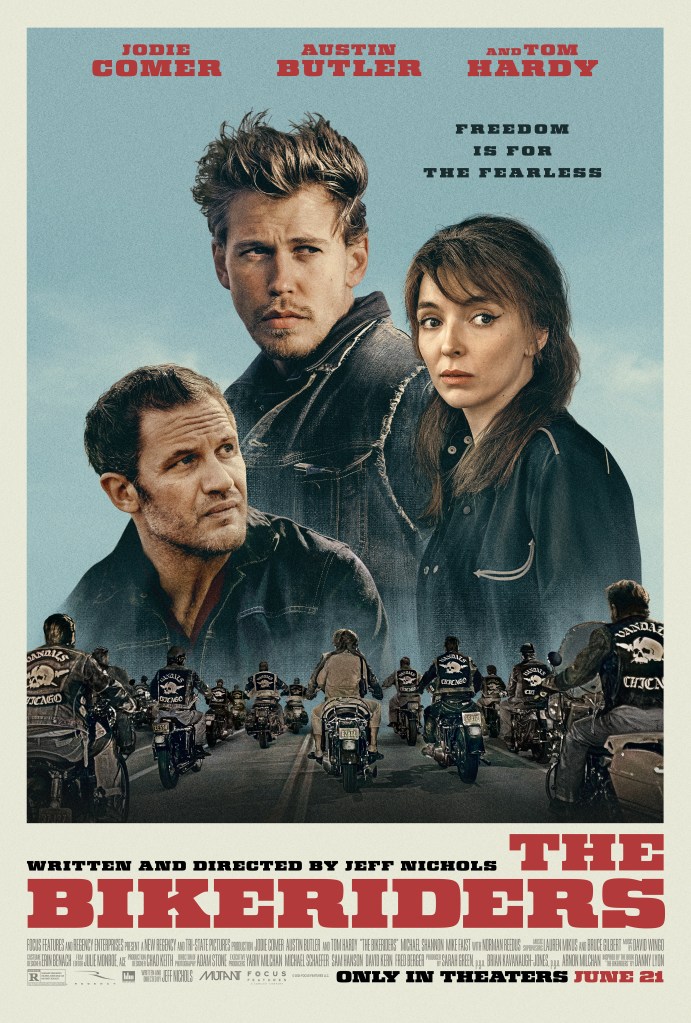
The film is inspired by Danny Lyon’s 1968 book of photographs, from which it gets its title. Lyon joined the Chicago Outlaws Motorcycle Club from 1963 to 1967, during which time he took photographs and conducted interviews with the club. Nichols’ film follows a similar yet fictional 1960s motorcycle club also based in Chicago: The Vandals.
Led by their president, Johnny (Tom Hardy), the Vandals feature quite the cast of characters, including Zipko (Michael Shannon), Cal (Boyd Holbrook), Brucie (Damon Herriman), Wahoo (Beau Knapp), Cockroach (Emory Cohen), Corky (Karl Glusman), and, of course, Benny.
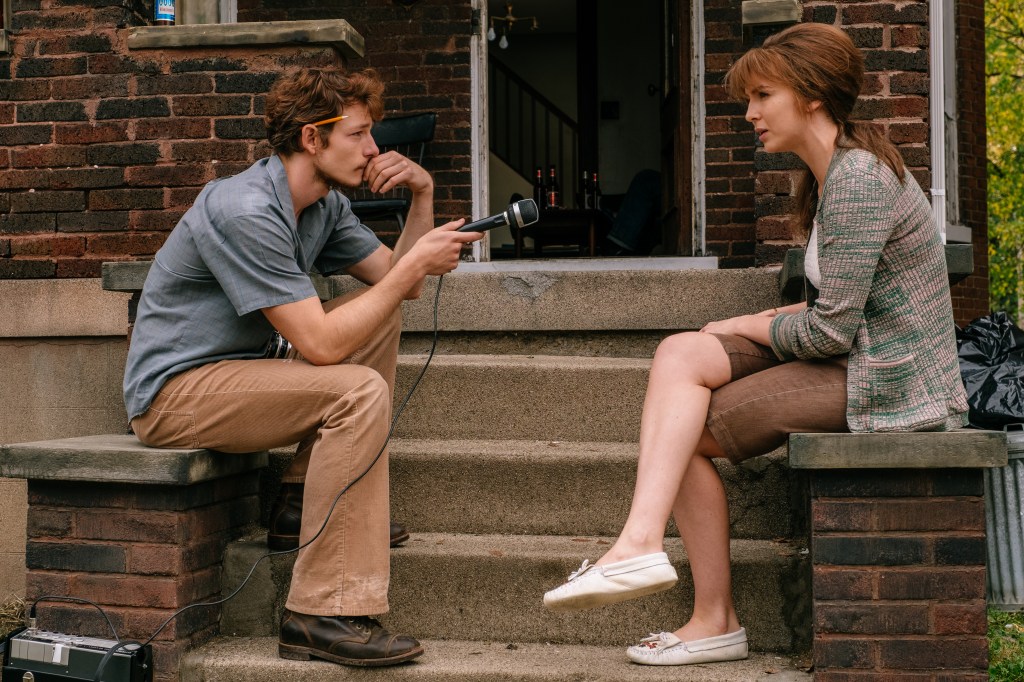
The story unfolds as Kathy gives multiple interviews (1965, 1969, and 1973, per Nichols) to the movie’s Danny (Challenger’s Mike Faist), sharing the history of the club—it was initially a racing club—what she knows about the guys, and the various trouble they—well, mostly Benny—have gotten into over the years, starting with her initial run-in with Benny at the bar.
It’s a scene that really sets the tone for how Kathy got wrapped up in Benny so quickly. The two are somewhat intensely making eyes at one another and exchanging cheeky smiles before Kathy informs Benny that she has to go home, and it’s everything. You fully understand how she married the guy five weeks later.
But Kathy isn’t the only character in the film with eyes for Benny—there’s also Johnny. Though the leader of this pack, he enjoys living vicariously through his young fellow Vandal. Day-to-day, Johnny’s a family man with a trucking job. But when Benny gets arrested for numerous traffic violations, he’s not mad at the kid; he’s impressed.
When it becomes clear that Benny is willing to put himself in harm’s way—even when on his own—the real conflict begins between Kathy and Johnny.
Performance-wise, Comer owns the screen as Kathy. As the film’s narrator, Kathy vividly—and candidly—recalls what’s she’s experienced firsthand as well as what she’s learned through her time being around the Vandals. She also doesn’t hesitate to call them out, when asked her opinion of things by Faist’s inquisitive Danny. Comer’s commitment to leaning into the real Kathy’s not-so-Chicagoan accent was ingenious, and adds a certain charm to Kathy’s storytelling prowess.
And then, we have Tom Hardy doing Tom Hardy things. The choices he made with Johnny, from the Marlon Brando-esque accent, to how he carries himself and moves on-screen, and interacts with his fellow Vandals is captivating. Moreso, you see how his inner-want to be more like Benny color these interactions.
With Benny being a man of few words, a lot of how he communicates is conveyed on-screen through body language. To Butler’s credit, he is able to express a great deal with just a look. Even during a lighter moment when Brucie is reading aloud an article about Benny’s arrest and upon noting the use of Benny’s given name—Benjamin—the actor offers a playful eyebrow raise without uttering a word. Personally, it’s one of my favorite moments of the entire film.
As the intrepid photographer Danny, Faist is relaxed, yet engaging as he gets Kathy and members of the Vandals to open up and talk about their lives with him. There’s a chat with Cockroach and an exchange with Zipko about college that particularly stand out as his character chats and shoots with ease. A highlight is during a scuffle with another club, Danny just casually steps out of the way to avoid being run into as he captures the events around him.
Throughout the film, there are frames where if one was to hit pause, it would be quite the picture—actors or otherwise. There’s this brilliant shot of a dozen or so cigarette butts surrounding Benny’s bike after he spends the night parked across the street from Kathy’s house, and through it’s brief, it’s memorably eye-catching.
These moments in the film make what Nichols ultimately accomplishes with The Bikeriders all the more special. Being able to take a book of photographs and breathe cinematic life into them is a wonderfully audacious feat that is worth taking a trip to the theater to watch on the big screen.
Also, of note, I’d be remiss not to recommend staying through the end credits while Lyons’ original photos are being shown–they’re the cherry on top of a tremendous film experience.
 Probably at the Movies